Renewable Project Readiness Engine (RPRE)
Takes a solar project from a set of assumptions to a structured readiness assessment — technical, financial, and the risks that actually stop projects — in one auditable model.
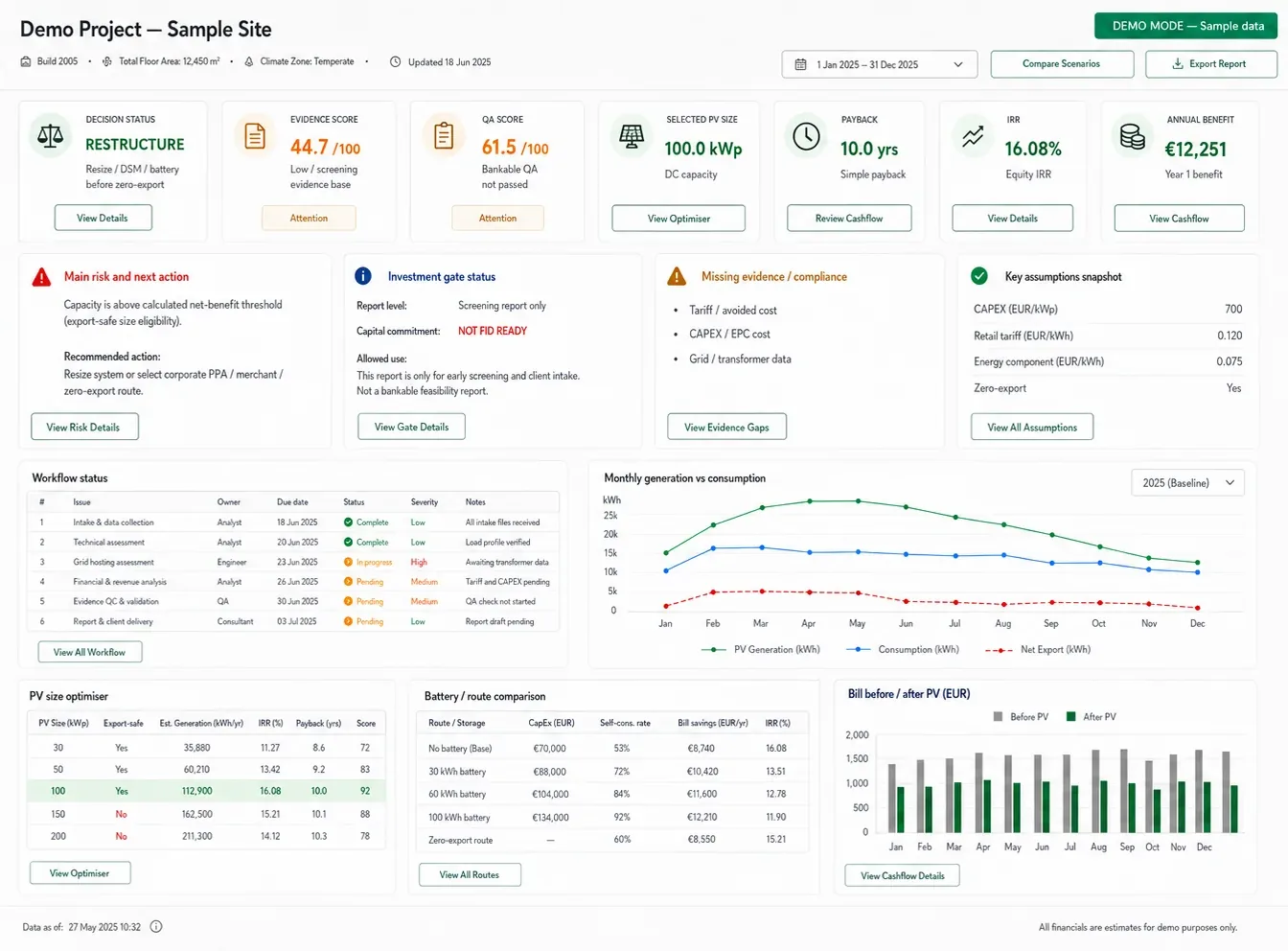
What it looks like
Decision supported
Whether a project is ready to proceed, what specifically is blocking it, and what would have to change for the answer to become yes.
Intended user
Developers, EPCs, municipalities and public institutions, and investors screening a pipeline.
What goes in, what comes out
- Site location, orientation and available area
- Resource assumptions and expected yield
- Connection point and available capacity where known
- Capex, opex and financing structure
- Tariff or offtake arrangement
Renewable Project Readiness Engine (RPRE)
- Dashboard summarising readiness across all dimensions
- Technical and financial assessment sheets
- Readiness scoring against defined criteria
- Risk matrix identifying what blocks the project and how severely
- Client-facing report and an audit trail of every assumption used
What goes in and what comes out. The model itself — its formulas, weighting and optimisation logic — is method, not proof, and is not drawn here.
Methodology summary
Nine linked worksheets — Dashboard, Inputs, Benchmarks, Technical, Financial, Readiness, Risk Matrix, Client Report and Audit Notes. Configured separately for rooftop prosumer installations and for utility-scale projects in the 5–20 MW range, because the constraints that bind differ completely between them.
Limitations
- Screening and structuring tool, not a substitute for a grid connection study, a geotechnical survey or a structural assessment. It tells you which of those you need and why.
- Benchmarks are calibrated to Kosovo and the immediate region. Applying them elsewhere without recalibration would produce confident, wrong answers.
- The model does not produce a financing verdict. Lenders decide bankability; this establishes whether a project is coherent enough to put in front of one.
Public preview
Access model
Applied within a project-readiness engagement, with the completed model and its audit notes handed over.
A piece of this is public
The energy balance at the front of this model — what a system generates, how much of it a site can use, and what that is worth in year one — is published as a free quick screen. The financial model, hourly dispatch and connection logic described above stay inside the engagement.
PV Feasibility Quick Screen →